31 January 2007

Children's Library of the Future?

We don't need libraries anymore? Right?

Thank goodness that not everyone is so narrowsighted as to think that children only need spacious classrooms, computers and the internet to develop their creative talents, and foster a thirst for enquiry and knowledge.

I suggest that good 'future' thinking is what is really needed, and as usual (when it comes to design) the scandanavians are right into it!

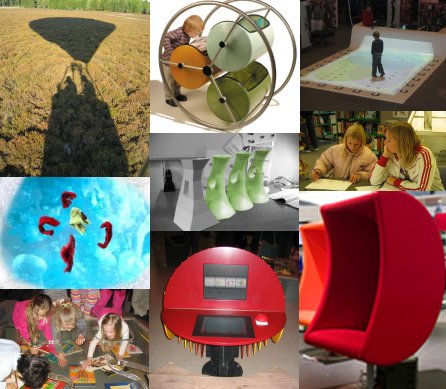
Imagine a children´s library where movements activate the room and elements in the library, and where imagination is stimulated by sound, images and light. And at the same time it is possible to place oneself in isolation and become deeply absorbed.


How do we create a physical and virtual sensation of being inside and outside, of being both alone and part of a social group?


Here we have an entire conference devoted to this theme - The Children's Interactive Library - with presentations available for download in pdf form. Amongst these papers you may find ideas and inspiration for tackling the "learning spaces" agenda that we began to discuss in 2007.


Let's keep the focus clear - libraries do have a valuable place in our schools and communities!

We know that the information society is changing, and that the way children look for information and the way they use information is changing.


The question is whether we as libraries are also keeping pace with the change and if so; is it in the right direction and in what way are we involving children – with their different talents - in this proces ?


Innovation is what it is really about!


How are we going to go about this?

29 January 2007

23 Things Aus-Style

Try to get in on this SirsiDynix Institute Webinar which is being presented by staff of Yarra Plenty Library in Victoria at the special time of 12.30pm Sydney time on Tuesday 6th February. As these online events usually happen at about 3 am our time, this is a great opportunity, although during lunch isn't the best time to get away from the library crowd in schools. If you can get relieved for an hour it does add up to very cheap PD. Otherwise wait for the podcast version which should come up over the following week.

Why would I bother? I hear you ask. Lynette, Denise and Christine put it best:

Yarra Plenty Regional Library in Melbourne Australia enthusiastically took up the fabulous PLCMC 23 Things program in October, and our staff has engaged with alacrity and creativity. We know that libraries have to change, and we are opening up possibilities for our staff and our users.

We will talk about why we decided to implement Learning 2.0, how our staff experienced it, and how this has equipped us to get bold in our thinking about social networking. We'll discuss the 4 themes for our Library worker 2.0 staff development program in 2007 - getting information, enabling learning, creating content and celebrating culture; and how we are encouraging an environment of lifelong learning within the organization. (SirsiDynix Institute)

This is an idea with lots of potential for all school staff and one whose time may just have come - and in time for FOL 5 program submissions?

28 January 2007

2007 Printz Award for Young Adult Literature


This most recent of the major US awards is proving a great showcase for Australian authors. After the success of Markus Zusak and Margo Lanagan last year with Honors for The Messenger (US title:I am the Messenger) and Black Juice, Zusak has done it again with The Book Thief. This time he is joined by Sonya Hartnett in Honor status for Surrender. Very well earned kudos for both authors, and interesting that both books were published as adult titles in Australia.

Although I admit to not being a particular fan of The Book Thief, I know I am in the minority with that opinion (and must admit that parts of the book resonate with me still). The Book Thief also won a hard fought battle to take out both the Jhunt Award and The Karen Sue Simonetti Cover Art Award. The Jhunt is a survivor-like contest run each year by the very active YA discussion list Adbooks.

Not to be too parochial, let’s acknowledge the actual winner of the Printz which is an interesting first as it is a graphic novel: American Born Chinese by Gene Luen Yang. This is also the next discussion book for Adbooks and I was thrilled to find it at Dymocks’ Macquarie Centre yesterday after ringing around half a dozen stores within cooee of my home. Have just started and am hooked. The blog at Manhasset Library TeenZone has a nice cover picture and annotation. Gene Yang is also a teacher and has a passion for using comics in education.

2007 Newbery Medal Winner

Just in case you haven't heard (and have a manuscript of your own in the bottom drawer) :
a librarian has won the Newbery award for children's literature this year.

The 2007 Newbery Medal winner is The Higher Power of Lucky written by Susan Patron, illustrated by Matt Phelan, published by Simon & Schuster/Richard Jackson.

In “The Higher Power of Lucky,” Patron takes us to the California desert community of Hard Pan (population 43). Ten-year-old Lucky Trimble eavesdrops on 12-step program meetings from her hiding place behind Hard Pan’s Found Object Wind Chime Museum & Visitor Center. Eccentric characters and quirky details spice up Lucky’s life just as her guardian Brigitte’s fresh parsley embellishes her French cuisine.

“‘Lucky’ is a perfectly nuanced blend of adventure, survival (emotional and physical) and hilarious character study... as well as a blueprint for a self-examined life,” said Newbery Medal Committee Chair Jeri Kladder. “Through Lucky’s experiences, we are reminded that children support one another just as needy adults do.”


Here's an excerpt from "Patron and Wiesner Discuss their Award-Winning Books"

This story originally appeared in Children's Bookshelf on January 25, 2007 by Diane Roback, Children's Bookshelf -- Publishers Weekly, 1/25/2007

Some old habits die hard. Susan Patron, a Los Angeles librarian who served on the Caldecott committee back in 1988, remembered that "the call" to the winner was traditionally placed on Sunday night, in advance of the Monday morning announcements. "We all have that little hope—you dream about it,"she said, of her Newbery chances for The Higher Power of Lucky
[Atheneum/Jackson) . However, since she was under the impression that the call came on Sunday, when the phone didn't ring, she thought, "It's OK, I'm moving on.".........

As juvenile materials collection development manager for the Los Angeles Public Library, Patron says she's very accustomed to trying to gauge the possible award winners each year, to have them in stock for library patrons.

"Lucky was not among the books being buzzed about, not on any mock Newbery lists," she says. "It didn't make a splash. I truly did not expect anything. So it was a great shock."


She's been a librarian for 34 years, and says the award is especially meaningful to her because it was given by her peers.

From Martha Baker
_________________________________________________________________________
Bibliothek / Library - Salem International College - Kurt-Hahn-Str. 1 -
D-88662 Überlingen - Germany

25 January 2007

Share your files anywhere, anytime!

In November 2006 I wrote about Box.net - our Web 2.0 sanity box - providing free storage, and linking of resources for blogs, myspace etc. We have a link in the right-hand navitation bar to quickly create your own space.

Mashable writes that now they’ve created a new Box.net widget , which adds even more functionality.

The Flash-based widget allows you to share all kinds of files: anything on your computer, plus music, photos and videos. Many of these file types can be viewed in the widget itself: you can view a photo, for instance, or play an MP3.

You can also transfer files between widgets: visit the MySpace page of ex-Grateful Dead bassist Phil Lesh and you can copy his music to your own widget, or just download it. (ohh, copyright.....)

Click on the image below and take a closer look at the widget!

24 January 2007

Literary Award Winners

The American Library Association announced on 22 January the literary award winners for books and videos for children and young adults. These include the Newbery and Caldecott awards.


The list can be found at the following:
American Library Association announces literary award winners


18 December 2006

And the winner is...

Take a look at the list of winners in the 2006 Edublog Awards
Or to cut straight to the chase go to Hey Jude

Well done Judy!

14 December 2006

The Blended Librarian


Ever wondered why you are so tired all the time? Well, someone has found a name for the job we teacher librarians do and it explains everything:

"A blended librarian is one who combines traditional library and information technology skills with instructional design and technology skills and knowledge of collections of instructional resources and current trends in developing and distributing instructional resources. The blended librarian uses this combination, along with a heightened emphasis on pedagogy, to collaborate with faculty, information technologists, and instructional technologists/designers on the design of information literacy that is tightly integrated into the individual instructor’s courses and with broader programmatic curricular goals." http://www.ala.org/ala/acrl/acrlproftools/collaboration.htm

Find out more about Blended Librarianship and join this community at The Blended Librarian website. Expect a day or so delay for approval, and then explore what is on offer.

To hear the founders, John Shank and Steven Bell, download this Learning Times Green Room Podcast. The Green Room people made the mistake on an earlier podcast of commenting that librarians may be redundant soon. John and Steven beg to differ.

08 December 2006

Marco Torres

Yesterday I was fortunate to ‘experience’ Marco Torres. What an inspirational afternoon – those who have attended his sessions this week are sure to agree. He made his work appear so easy – however, this man obviously has enormous energy and talent.

+ What did I take away -

1. Good pedagogy underlies and is implicit in his work
and
2. in practical terms -

+ We have Three options
  • Complain
  • Quit
  • Innovate
+ Focus on ‘yes but’ group – they provide the best opportunities to innovate
+ Essential question is critical (this links to our 2006 AGQTP project at St Michael’s: higher order questioning)
+ Remember Einstein’s quote, ‘Don’t ask a question if you can look up’ [= ‘Google it’!]
+ When planning – always ask ‘Does the project have wings?’ – is there a wider audience outside the classroom?
+ Students don’t use technology, they do technology
+ Music is very important : Music is the ugly stepchild in multimedia : so - Find the musicians in the school and use them in multimedia projects
+ Be resourceful: Too many schools have many resources, but are not resourceful; Many schools have limited resources, and are resourceful
+ Creativity is the key - Remember the red paper clip – http://oneredpaperclip.blogspot.com/
+ Connect to the family
+ Connect to the community

Today my head is spinning – where to begin, and begin I will. It could be easy to be overcome by the quality of his projects, however, creativity with few resources is possible. There is no question students are motivated by technology, we all have supporting evidence - My experience with students and movie making has been exciting. I believe the real key is getting the pedagogy right – having the essential question.

If you have been one of the fortunate people to have Marco in your classroom/school this week – please share. We can all benefit from your experience. In the meantime -
1. Visit his website http://homepage.mac.com/torres21 .
2. Open sfett to view inspirational student produced movies.
3. Open flickschool for tips on getting started.

Wiki ideas for the classroom


So how do I use wikis with my classes?


Go no further for the answers!

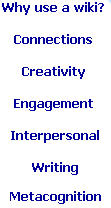
Wiki Ideas for the classroom provides a flash tutorial outlining all the benefits of wiki, and all the practical considerations for good learning and teaching.

Not only are the learning and design issues covered, but the tutorial also provides information for consideration of safety, spelling, copyright and more.

Some suggestions include: a study guide; vocab list; organizational 'epicenter' for your student's learning on a topic (see the Aristotle experiment); collabortive research projects; an “everything I needed to know I learned in Ms.Teachername’s class” wiki where students add their own observations of ways the class knowledge has spilled over into the “real world”; A travelogue from a field trip or NON-field trip that the class would have liked to take as a culmination of a unit of study; and more....

For more information you may also go to Mark Wagner "Wikis while you Work: an Introduction to Wikis in education".

The tutorial is designed to support WikiSpaces which we promote on this blog.

06 December 2006

Travelling with Delicious ...

This week is Transition week for Year 10s at Delany.

One of their sessions is an introduction to Delicious, and the creation of their own 'digital bookshelves' for their coming 2 years in the senior school.

We took the time to explain that when the new Intranet comes, they will be able to link their delicious accounts into their Intranet resources and have the best of both worlds.

Delicious has networking, but no chat or other contact between users, so it can be difficult to identify network members. We have asked students to precede their chosen username with DC and end with their year level. So DCsweetpie11 and DCalistair12 would be easy to identify as our students. They seem happy enough with this.

I think Marion College has also set up Year 10 with delicious accounts too.

Any other schools introducing Web 2.0 tools to their senior students?

Jan@Delany

04 December 2006

Podcasting book talks!

A great idea from Michele Velthuizen Middle School Librarian American School of The Hague

"I recently started encouraging our middle school students to create video podcasts about their favorite books since peer recommendations sometimes work better than my own booktalks!

I set up my computer (a Mac Book Pro which has a built-in camera and microphone) in our reading room and have students come in during lunch break to create their recordings. They rehearse for a minute, then they record themselves using QuickTimePro which has a movie recording feature that is very easy to use. I then upload the podcast onto our library web page within minutes.

I've used these podcasts when classes come in to check out books and update their reading cards.

Click on this link http://fc.ash.nl/~mvelthuizen/, then click on "Watch a video podcast" on the main screen to see some samples.

To follow up from Marita's post on graphic novels, you might like to check out iFanboy.com.

The iFanboy.com Comic Book Podcast is a weekly talk show discussing the best in current comic book releases.

Ron, Conor and Josh will share what they loved and hated about the week's comics. With a deep, sometimes scary knowledge of the depths and intricacies of pop culture and the geek lifestyle, the conversations can spin off in many directions. While comics, graphic novels and trade paperbacks are the center of the iFanboy universe, the discussion often covers the video games, movies and TV shows which will capture the fancy of your regular comic book reader.

Something different for older students.

28 November 2006

Getting Graphic

I started a new discussion at Read On today asking people to share student’s current favourite reads, with a view to starting some recommended lists for various age groups. Please join in when you get the chance – it will be interesting to compare notes.

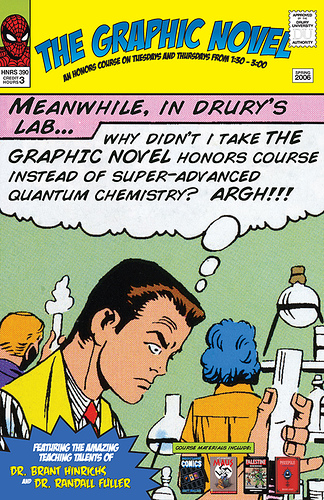
When answering my own question first thoughts were about our comic collection, maybe because this was discussed on OZTL last night. Here is a bit of what I posted to that discussion, plus some local additions to the literature:

At Patrician Brothers our graphic novels are a big hit across the board. Like certain series books (Harry Potter, Deltora Quest, Alex Rider, Darren Shan) they have an appeal to reluctant and avid readers alike. In this sense they are a real boon in our efforts to develop a reading culture. Whilst many boys read books as well, some are having their first (and maybe only) positive reading experience with comics.

Earlier in the year I was travelling home on the train from our athletics carnival with the boys and was chatting with one of our very avid Year 8 readers. He was reading a graphic novel and said to me that it was actually taking him longer to read than a novel (and he is a very fast reader). We had an interesting conversation about why that might be. I don't think we should undervalue the visual.

Favourite links to resources on this topic:

Secret Origin of Good Readers
Free book download. Check down the page for the 2006 version. Plenty of quotes,links, annotated reviews, information for librarians and teaching activities.

The "Decline" of Reading in America, Poverty and Access to Books, and theuse of Comics in Encouraging Reading by Stephen Krashen, Teachers CollegeRecord, February, 2005 (More in Krashen's book The Power of Reading - search here for local publication details)

Di Laycock of Barker College has published an article and completed an action research project on graphic novels, adding a much needed Australian flavour to this field:

Developing a Graphic Novel Collection, Synergy, Vol.3, Num.2 (PDF)

Getting graphic with guys: Using graphic novels to engage boys in school reading From this page choose IBSC 2005/06 Action Research Project from the menu on the left.

Okay, I know you don't have time for all this reading. Maybe in the holidays?

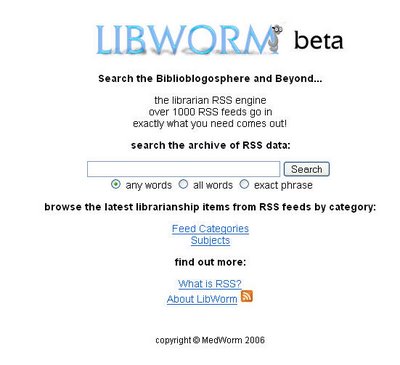
Search the Biblioblogosphere and Beyond


It's worth taking a look at LibWorm to find the latest items of interest in librarianship - join LibWorm and create your own reading list, collect your favourite feeds, or just collect clippings. Choose from Feed Categories or Subjects. Nice one!

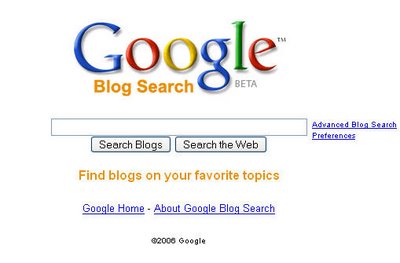
Of course, this also had to come along from Google! Go take a look!

24 November 2006

Web2.0 & Primary Students

I wish to share an ICT initiative from St Michael’s, Baulkham Hills, and I hope we receive some responses to guide our future planning!

A colleague and I attended an Introduction to Podcasting course and as a result our Year threes and a class of year 4s have been introduced to podcasting this term …by two novices! They have been our second ‘group’ of learners to embrace Web2.0.

Audacity [free download] is the program we are using for creating the audio file, then using Lame [free download] to convert the files to MP3. We are yet to load the files to the web. Our students have been highly motivated by the opportunity to publish their research and understandings using podcasting. This is the positive aspect of the tool, combined with the students demonstrating some prior knowledge and understanding of audio - In year 3 we were able to add some ‘zing’ to the important [dry!] topic of Recycling!

Evidence from this exercise has informed us of the possibilities of podcasting with younger students. We have the opportunity to combine this with evidence gathered from our St Michael’s AGQTP project. Both projects indicate high levels of student motivation when they engage in a social networking environment. We used www.think.com as the tool for social networking in our AGQTP project. In that project, we were able to gather data not only related to our research question, but on many other areas including the social and ethical use of computers. For example: we elected to use the online tool Think.com as a secure environment for our research project. Several discussions were held with the students regarding social and ethical behaviours in the Web2.0 environment. Despite this, we had evidence of inappropriate comments from [unexpected!] students towards others. Think.com was therefore a scaffold, a secure and controlled environment - valuable discussion ensured, thus scaffolding primary students into the Web2.0 environment.

Moving into 2007, I foresee a wider use of these two environments at St Michael’s.
Radio WillowWeb scaffolds students, and I believe this is a model worth replicating as we enhance student learning. Think.com has the facility to upload multimedia files [i.e. podcasts], thus providing a secure environment to develop our students’ ethical use of the Web2.0 environment.

Please comment and give us encouragement to keep developing ‘authentic’ Web2.0 educational pedagogy in our large primary school…with all its associated issues relating to access to hardware etc etc!