Last week over 180 teachers from Catholic schools in the Diocese of Lismore gathered at St Augustine’s Primary School in Coffs Harbour for a ground breaking conference on interactivity in the classroom.
Dr Anne Wenham, Director of Catholic Schools believes, “This conference is the first of its kind and a great testament to the existing skill base in our school. This technology has enormous potential to improve classroom learning and student engagement. We are proud of our staff and feel that these changes will gather momentum.”
The conference used the skills of over 20 teachers employed in local Catholic schools plus two invited keynote speakers, Dr Renata Phelps (Southern Cross University) and Judy O’Connell (Parramatta CEO) both known for their expertise in this area.
Conducted over two days and using classrooms with students present, this conference took on a very different approach to usual professional gatherings. Teachers participated in a variety of workshops on movie making, using Google in classrooms, Learning Objects, school intranet sites, Flash presentations, data projectors, podcasting and how to set up and use blogs and wikis. The classroom focus involved SMART, Promethean and Interwrite boards.
A wiki has been set up for follow up comments and ideas. Evaluations of the two days were extremely positive. Many teachers commented that this was the best professional development they had received. Already teachers are asking about next year’s conference. We would recommend this model of professional development to other school systems. If you are interested in more specific details of the conference please do not hesitate to contact us.
25 August 2007


20 August 2007
One Shot World Tour: Australia

"Best read with Vegemite......."
Get a different perspective on Australian literature through this great initiative from a bunch of non-oz bloggers. Along the way you will be taking your own One Shot World Tour of fantastic literature blogs.
Nick Earls by Colleen at Chasing Ray .
Get a different perspective on Australian literature through this great initiative from a bunch of non-oz bloggers. Along the way you will be taking your own One Shot World Tour of fantastic literature blogs.
Nick Earls by Colleen at Chasing Ray .
Margo Lanagan interviewed at Seven Impossible Things Before Breakfast.
Melina Marchetta at Writing and Ruminating.
Anna Feinberg and her Tashi series at Big A, little a .
Simmone Howell interviewed by Jenn at Not Your Mother's Bookclub.
Kathy Hoopmann's award winning All Cats Have Asperger Syndrome reviewed at Chicken Spaghetti.
How Sassy Changed My Life, The Red Shoe by Ursula Dubosarsky and more Margo Lanagan
by Gwenda at Shaken and Stirred.
John Marsden's Tomorrow series is discussed at Jen Robinson's Book Page
Jaclyn Moriarty and Penni Russon's Undine feature at Finding Wonderland
Alyssa Brugman's Finding Grace discussed by Little Willow at Bildungsroman.
Catherine Jinks and her four "Pagan" books by Liz at A Chair, a Fireplace & a Tea Cozy.
Does My Head Look Big in This? and John Flanagan's The Icebound Land feature at Interactive Reader
Queenie Chan interviewed by the YA YA YAs
Hot Men of Children's Literature: Australian Edition and John Marsden and "The Rabbits" (Part Two) (Part Three) at A Fuse #8 Production
Peter Temple interviewed at Light Reading
Am I Right or Am I Right? by Barry Jonsberg at Mother Reader .
Photo by Los Cardinalos
11 August 2007
Be Cybersmart: Researching the Internet Wisely
This video comes from a series produced by The Mid-Atlantic Regional Technology in Education Consortium (MAR*TEC) at Temple University in partnership with The CyberSmart!® Education Company. In this video Joyce Valenza (internationally known teacher librarian) provides a great overview of the issues to consider in researching the internet wisely. Show it to students, staff meetings, or parent information sessions.
The purpose of these videos is to introduce the "new literacies" to educators — the challenges of safe, ethical, and effective technology use in support of teaching, learning, and living in the 21st Century. Further videos on Internet Safety, Social & ethical issues, and more are available here.
In2Edu - Education treasure trove!

"I think and think for months and years. Ninety-nine times, the conclusion is false. The hundredth time I am right." Albert Einstein
The In2Edu site provides an astonishingly comprehensive range of approches and resources for teachers - including fabulous support information literacy learning in schools.
The site features an information literacy programme/model called STEPS, born of a desire to help pupils make sense of and be creative with information. What makes STEPS unique is the range of variations that enable you to adapt it to different curriculum areas and different ages.
All 5000 best education links/favourites/favorites on this site were updated/verified July 2007.
They have developed a full information literacy programme similar to BIG 6/ SAUCE etc. It is supported with a range of downloadable resources and online activities to practise skills. Materials, posters, teaching tools and ideas are available across many curriculum areas. In fact, it takes ages to navigate all the dropdown menus and links to discover the wealth of information available. Rich tasks and deep thinking is included, and Blooms taxonomy underpins the rubrics.Check out the downloads available, or navigate to the 'rich topic' curriculum choices below.

21 July 2007
Audio Books @ Delany
 I have been buzzing all week after the great input Jan shared at the Literacy Conference at Delany. The information was both very practical and thought provoking.
Jan gave details as to how to set up the system in the Library as well as very sound reasons as to why we should be exploring such systems to improve student outcomes, especially in Literacy areas. The staff at my school have had me quoting Jan every day at every opportunity ALL WEEK! What a great session!
I have since thought about how to take advantage of the concept in a Primary School Library, considering limited budgets and resources. I was thinking of 'taking on' the challenge to conduct a Professional Action Research Project on this topic this term. I'd love to get some input from the collective wisdom of our group. Feel free to give any advice...and as much as possible...!! If there is anyone who would like to join me for a group effort that would be great too!
Frances
12 July 2007
Joining the blog
Hi, I am Suzanne Singleton-Brown . I work as a Teacher Librarian for three days at Wakehurst Public School and .3 days at Our Lady of Perpetual Succour Primary school. In a week I connect with 500 students through the two schools. Originally I was a Science Teacher ,so changing to being a Teacher-Librarian was an exciting learning experience. My initial experiences were mainly in reorganising both libraries to make them more user friendly. One is housed in a huge space while the other is in a tiny classroom. Both spaces now provide areas for children as they move through their school life, having separate beginning, intermediate and senior reading and research sections. Resources are nearly all computerised and we have experienced three different computer systems Oasis, Alice and Athena. This term I am going onto Client in the State system so my transition from Science Teacher to Librarian has certainly offered me challenges.
30 June 2007
VoiceThreads in the Classroom

I have just been exploring the possibilities of VoiceThread. This website allows you to upload photos and add an oral commentary to a photo. If you don’t wish to record audio you can add text instead. Clear video instructions are given to set up a microphone for both Mac and Windows XP. VoiceThread is free for educators and students.
What a great place to store book reviews for your school!
What for....?
During the week I had a really grounding experience in relation to my use of Web2.0 tools and the reasoning behind it. I thought it would be worth mentioning, as I read with interest the comments earlier in the term about the use of the Bibliosphere Blog. I am also an avid reader of different blogs and articles on the use of Web2.0 tools in education…and how we, as educators need to keep up with the ‘digital natives’.
Here is ‘my story’! I had just finished a lesson with some six year olds where we had made a wiki about animal homes .We put the work in a wiki, to show their parents, all the things they had learnt, (skills & ‘content’). We also discussed how the students could look at that work in the classroom or over the holidays…etc etc. After the lesson I had another student bring me some work on ‘Dragons’ he had done on his own. As a reward, I offered to help him put the work on a special site on the Internet so that his parents could see it (I ran off all the ideas we had listed in the previous lesson with the six year olds.)
He simply said “What for…” & that statement ended up haunting me for the rest of the day!
“What for…” Are we asking these questions BEFORE we enthusiastically ‘embrace’ these tools in the classroom? Don’t get me wrong, I fully support their use and will continue to do so……
But are we being discriminative in our use?
Are we really using the best tool at the time for the intended audience?
Who are we anticipating IS our audience?
Who is meant to be using the social networking sites we construct and how do we set these up so that they ARE exploited to their fullest potential?
Why are we using these tools in particular educational contexts, is there a real purpose in that they will enhance student outcomes?
....Are we starting from the ‘right’ perspective?
I know I have a great looking library blog that has never had a comment, (although our parents do view it as they mention this to me). I also set up, with a Year 6 teacher, a Blog for the class where the intention was simply to give them a forum to have a voice. The Year 6 blog is used all the time. One student even made a comment one Saturday night within minutes of me posting! Do we simply accept that different blogs/Web2.0 developed sites have different purposes and leave it as that?
…..I posted a quote from a blog entry called 'A Problem with Blogs' on our staff blog. I’d like to hear what other TLs think! As TL's we often lead our staff in adopting new technologies, do others experience these moments?
Maybe we could start ‘a conversation……’ about it!
-Frances
28 June 2007
Medieval helpdesk with English subtitles
I thought I'd introduce myself with this great video. Liblogger is my blog name-I'm Frances Manning a Primary Teacher Librarian. My Blogs are INFOZONE and hfsconversations and I am involved with a few class blog projects. I believe in our job you've got to have a sense of humour....this video really spoke to me! How do others feel about the message?
27 June 2007
Love letter to a favourite book
 Whilst searching for a picture book activity on Read Write Think today I made a couple of happy discoveries. The first was an activity which involved making a book which was an artwork in itself and came from Susan Kapuscinski Gaylord's Making Books With Children site. There are several beautiful free projects to run with there as well as books to buy with more ideas.
Susan also has a blog and this is where I read about a project she was involved in earlier this year called Love Letters to Our Favourite Books. The Newburyport Literary Festival ran this last April with an exhibition of hundreds of these love letters, mostly from children and through several local libraries and schools. The idea is to use an A4 or letter sized sheet of paper and present a tribute to a favourite book. Original text, quotes, drawings and all manner of art work can be used. It is feeling and imagination that reign supreme in the final product.
Read more about the project and see examples of the Love Letters in this PDF flyer from the Literary Festival. This is a very elegant activity which could be tailored to a number of celebrations for a wide age range.
25 June 2007
Pandia powersearch not to be missed!
 Pandia Powersearch is an extraordinary all-in-one list of search engines and directories.
Search the Web using the search window (with a dropdown set of choices), or select from extensive list of the best Internet search tools found by Pandia. Search for files, images, music, video, online reference, dictionaries, books and more!
Pandia Powersearch is a search service from Pandia Search Central.
"Kill the Vampires"
Reading Matters is one of those events that one always hears the best things about. It is a youth literature conference for professionals and young people organised by the Victorian Centre for Youth Literature. They get an amazing range of YA authors together each year, and this year I heard great things about David Levithan's contribution.
The good news is that there is now a ten minute podcast of Levithan from a panel called "Let's Talk About Sex". He is asking us to vanquish those voices in our heads telling us what our bosses, parents and others might think of the books we put in our libraries. His reflections on the Australian YA literature environment are interesting as is his no nonsense attitude to that last "acceptable prejudice", homophobia. As Read Alert says:
Listen and share: David Levithan:Kill the Vampires
It is also worth mentioning a review of Levithan's Boy Meets Boy by Chris Wheat in Viewpoint, Vol 13, No 3, Spring 2005 (links to the journal but not the article). More than a review, this is a heartfelt plea for this book to be in your library.
The good news is that there is now a ten minute podcast of Levithan from a panel called "Let's Talk About Sex". He is asking us to vanquish those voices in our heads telling us what our bosses, parents and others might think of the books we put in our libraries. His reflections on the Australian YA literature environment are interesting as is his no nonsense attitude to that last "acceptable prejudice", homophobia. As Read Alert says:
It’s a moving, provocative and inspiring talk about getting the right books to the teens who really need them........ And you need to do more than hear it. You need to copy it, you need to put it on your blog, you need to tell people about it, talk about it, think about it. It has a Creative Commons license, so use it as you will.
Listen and share: David Levithan:Kill the Vampires
It is also worth mentioning a review of Levithan's Boy Meets Boy by Chris Wheat in Viewpoint, Vol 13, No 3, Spring 2005 (links to the journal but not the article). More than a review, this is a heartfelt plea for this book to be in your library.
21 June 2007
New Contributor
My name is Sharon Brennan and I am the teacher librarian at St Augustine’s Primary School in Coffs Harbour, NSW. We have 620 students in 23 classes. Our school is part of the Diocese of Lismore. It is my pleasure to be a contributor to this blog. I began a library blog (Reading Rules) late last year and it is proving popular with our students. I am now encouraging other staff members to begin a blog with their class. I've just tried to link to my blog but have discovered that Safari does not support the formatting and hyperlink buttons on the posting screen. When the link becomes active, you'll know I have logged on using a supported browser.
16 June 2007
Designing the 21st Century Library
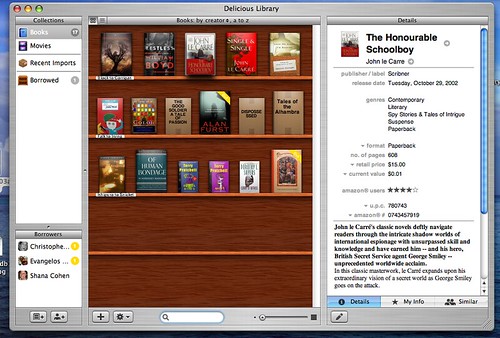 Flickr image: ‘deliciouslibrary OMG” by petit hiboux
Subscribe to:
Posts (Atom)


